Why Giving Daily Tests is a Must for Aspirants
An instructor handing out test papers to students in a lecture hall, capturing the routine of regular testing that helps aspirants build recall, track progress, and stay exam ready.
You read a chapter, feel confident, close the book, and think you've got it. Then a test comes along and half of it just isn't there. Sounds familiar? Almost every aspirant has been through this at some point, and it usually leads to the same wrong conclusion, that they simply need to read the chapter one more time.
But the problem was never how many times you read it. It's that reading and actually being able to recall something under pressure are two very different skills. The only way to build the second one is to practice it, over and over, which is exactly what a daily test does. This article gets into why testing daily works so well, backed by real research, and why it deserves a permanent spot in your prep, not just something you do before the exam gets close.
The Testing Effect: Why Recall Beats Re-reading
Most aspirants prepare by reading notes and textbooks again and again, believing that repeated exposure to information is the best way to learn it. Cognitive psychologists Henry Roediger and Jeffrey Karpicke challenged this assumption through a series of well known experiments. They found that students who tested themselves on material, even without any feedback, retained significantly more information a week later than students who simply reread the same material multiple times. This phenomenon, now called the testing effect, shows that the act of retrieving information from memory strengthens that memory far more than passively reviewing it.
For an aspirant preparing for a competitive exam, this has a direct and practical implication. Daily tests are not just a way to check preparation. They are themselves a learning tool. Every time a student attempts a question and pulls an answer out of memory, that memory pathway becomes stronger and easier to access the next time. Reading a chapter ten times builds familiarity, but testing on it builds retrieval strength, which is what actually matters on exam day.
Desirable Difficulty and Long Term Retention
Psychologist Robert Bjork introduced the idea of desirable difficulties, conditions that make learning feel harder in the short term but lead to stronger, more durable memory in the long term. Taking a test is uncomfortable. It forces the brain to search for answers instead of simply recognising them on a page. This discomfort is exactly why testing works so well. Passive study feels easier and creates a false sense of mastery, but that sense of mastery often disappears the moment a real question is asked in an unfamiliar format.
Daily testing exposes the gap between what an aspirant thinks they know and what they can actually produce under pressure. This gap is uncomfortable to face, but it is precisely the information a student needs. Identifying weak areas early, while there is still time to fix them, is only possible when testing is a regular habit rather than an occasional event before the exam.
Spaced Practice and the Forgetting Curve
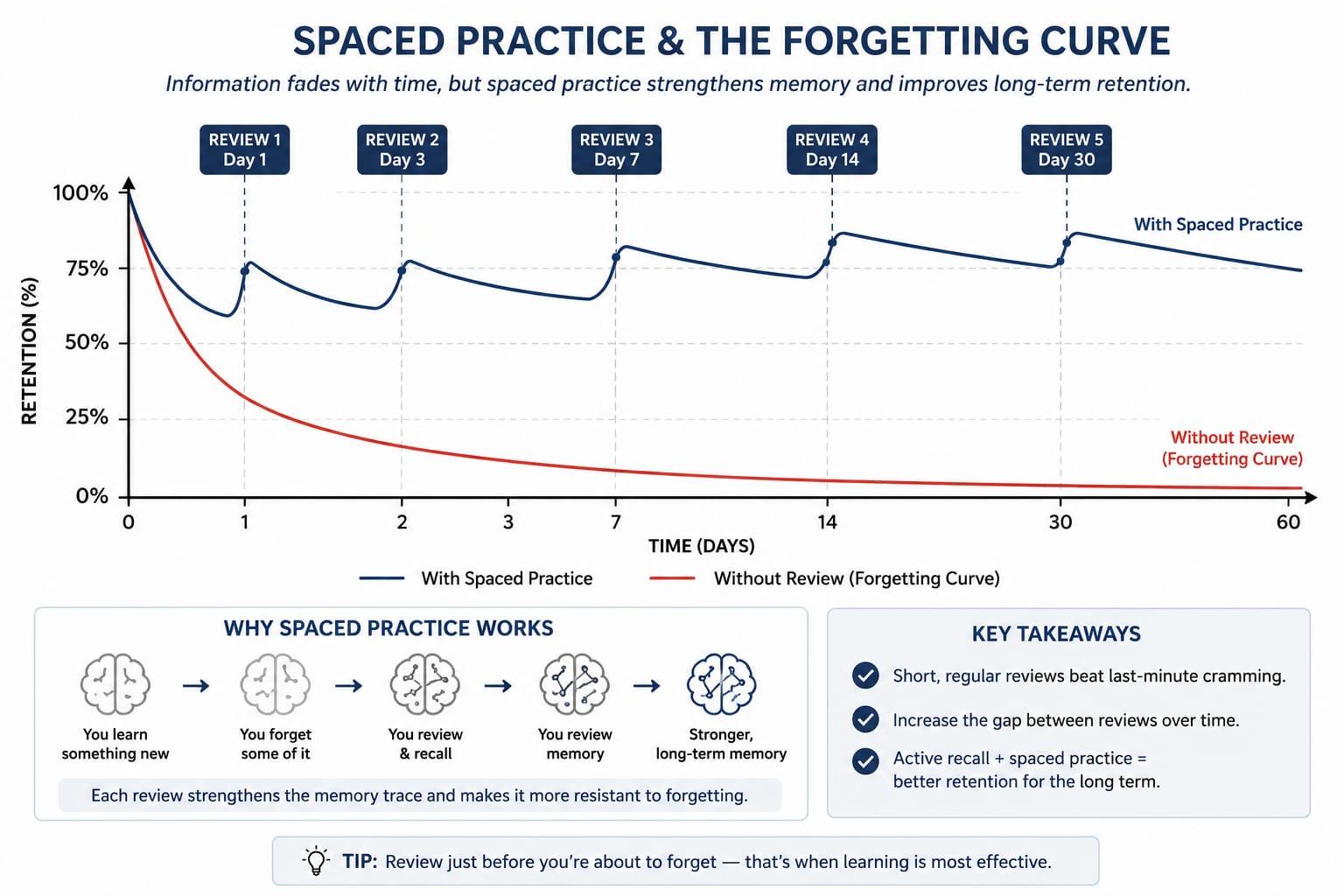
Hermann Ebbinghaus, one of the earliest researchers of human memory, demonstrated through his forgetting curve that information fades rapidly after it is first learned unless it is revisited. Later researchers built on this to show that spacing out practice over time, rather than cramming it into one long session, dramatically improves retention. Daily testing naturally builds this spacing into an aspirant's routine. Instead of learning a topic once and hoping it stays in memory until the exam, daily tests force repeated encounters with the same concepts across days and weeks.
This repeated retrieval at spaced intervals is what moves information from short term memory into long term memory. An aspirant who tests daily is, often without realising it, applying one of the most well established principles in memory science. Those who prepare only through continuous reading are far more likely to experience the frustrating feeling of forgetting material they were once confident about.
Building Exam Temperament and Reducing Anxiety
Competitive exams like the UPSC, CA, NEET, Banking & Others are not only tests of knowledge but also tests of composure under time pressure. A student can know an answer perfectly well while studying at home and still fail to recall it during the actual exam because of anxiety and unfamiliarity with exam conditions. Psychologist Sian Beilock's research on choking under pressure shows that performance anxiety often stems from a lack of exposure to the exact conditions of high stakes performance.
Daily testing acts as a form of exposure therapy for exam anxiety. Each test simulates the pressure of recalling information within a limited time, gradually desensitising the aspirant to the stress of the real exam. Over weeks and months, what once felt intimidating becomes familiar and manageable. Students who test daily walk into the exam hall having already faced that pressure hundreds of times before, which is a significant psychological advantage over those attempting it for the first time on the actual exam day.
Metacognition and Honest Self Assessment
Daily testing also builds a skill that is often overlooked, the ability to accurately judge one's own preparation. This is known as metacognitive calibration. Research by Karpicke and others has shown that students consistently overestimate how well they know material when they rely only on rereading, because familiarity with a page is mistaken for actual understanding.
Regular testing corrects this. It gives an aspirant concrete, honest feedback on which topics are genuinely strong and which only appear strong on the surface. This clarity allows for smarter allocation of the remaining preparation time, focusing effort where it is truly needed instead of revising topics that already feel comfortable. In a preparation journey that can stretch across a year or more, this kind of honest self assessment, repeated daily, is often the difference between aspirants who improve steadily and those who plateau without realising it.
Conclusion
Daily testing is not an optional add on to an aspirant's preparation, it is one of the most evidence backed methods available for learning, retention, and exam readiness. It strengthens memory through active recall, builds resilience through desirable difficulty, spaces out learning in a way that fights forgetting, prepares the mind and body for exam pressure, and gives honest feedback on real progress. Aspirants who commit to testing daily, even in small doses, are training in the exact way memory and performance science suggests is most effective, and this consistent discipline compounds into a genuine advantage by the time the real exam arrives.
Study 8–10 hours daily with accountability
Deep study sessions, guided meditation, and mental models — all in one place.